Energy Weekly
Use a seven-day view to plan your week
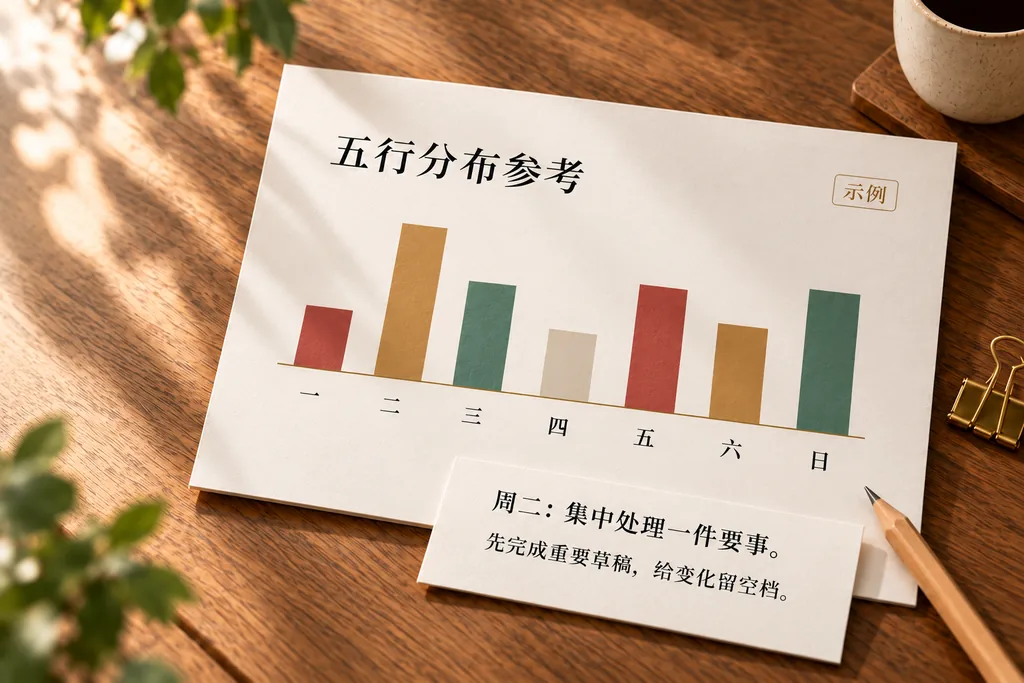
- See the seven-day rhythm
- Daily prompts and reflection
- Past weekly reports and PDFs
Bound to your own chart. No automatic renewal.
Pricing and availability are confirmed when you open this page.

Private web report + PDF
View sample
A Calm Weekly Rhythm Reference Before You Plan Your To-Dos
Every Monday my to-do list mixes deep strategy drafts with endless messages, turning the whole week into firefighting. By Friday my attention feels shredded while the work that actually matters barely moves. Before mapping out my own week, I want a calm pacing reference to help sort when to focus, connect, or slow down.
What changes the picture
Instead of pushing equally hard every day, match your own to-dos to the week's rhythm
Before you fill every day to the same density, give the week a centre of gravity. The report turns the calendar-based Five Element distribution into a weekly overview and seven daily prompts. Use them alongside your own list: protect a block for an important task, group smaller conversations and leave a little room to look back at the weekend.
From the chart to a useful next step
Your week at a glance
0–100 · Cultural reference
Zero baseline · Bar heights use the full 0–100 scale.



Monday · Express and draft
丙寅 · Lunar 2026, month 9, day 10
Planning prompt
Turn one idea into a draft or checklist, then check that another person understands it as intended. Use the structural contrast as a review prompt: check for scheduling conflicts and leave room to adjust.
Reflection question
Which sentence or next step could be clearer?
Index breakdown
Start at 50. Count each visible natal stem and branch as one element; omit an unknown hour pillar. Hidden stems, seasonal weights, and favorable-element judgments are excluded. Concentration H=Σ(element count/total count)². Add the daily stem, then the daily branch. Each adjustment is 100×(H before−H after), rounded to 2 decimals. Add both to 50, round to an integer, and limit to 0–100. Positive means more dispersed, negative more concentrated. Ten-god labels and branch relations do not change the index.
- Base value
- 50
- 丙 · FireH 0.218750 → 0.209877
- +0.89
- 寅 · WoodH 0.209877 → 0.200000
- +0.99
- Adjusted total
- 51.88
- Reference index
- 52 / 100
Calculation inputs: Wood 1 · Fire 1 · Earth 2 · Metal 2 · Water 2 · 丙寅
Rule version: visible-elements-balance.v1
- Relative to natal day master 乙, daily stem 丙 has the traditional ten-god label Independent expression (伤官). This edition maps it to “Express and draft” as an editorial planning prompt, not a measurement or prediction.
- The day's branch 寅 and natal year pillar branch 申 form an opposition in the traditional system. This is a structural label, without a good/bad prediction.
- The day's branch 寅 and natal month pillar branch 申 form an opposition in the traditional system. This is a structural label, without a good/bad prediction.
Chart profileLinked chart · One bound chartView profile
- Linked chart
- Linked chart
- Day Master
- 乙
- Four Pillars
- 壬申 戊申 乙丑 壬午
How it is calculated
Planning prompts for your week
Explore each day’s theme, calendar facts, and reasoning. Choose practical steps around your actual commitments; all seven themes have equal standing.
Generated locally by the site’s deterministic chart engine, without AI. The daily stem’s ten-god relation selects one of five editorial themes; repeated, paired, and opposing branches are checked against every available natal pillar and listed only when they match.
Start at 50. Count each visible natal stem and branch as one element; omit an unknown hour pillar. Hidden stems, seasonal weights, and favorable-element judgments are excluded. Concentration H=Σ(element count/total count)². Add the daily stem, then the daily branch. Each adjustment is 100×(H before−H after), rounded to 2 decimals. Add both to 50, round to an integer, and limit to 0–100. Positive means more dispersed, negative more concentrated. Ten-god labels and branch relations do not change the index.
Calendar reference Calendar facts use 12:00 in Asia/Shanghai; year/month pillars follow solar-term instants and term markers use local dates. Noon is a calendar reference, not a recommended time for action.
Time zone: Asia/Shanghai
- The index describes a rule-based change in visible-element concentration. It does not rate a chart, assess strength or favorable elements, measure energy, or predict health, wealth, or outcomes. A higher value does not mean a better day; a lower value does not prohibit action.
tyme4ts 1.5.2 · 2.0.0
The whole week
2026-10-19 — 2026-10-25
This image comes from the actual weekly report component for October 19–25, 2026. Read all seven days before placing deep work and conversations into your own schedule.
One day in focus
2026-10-19 · 丙寅 · 52 / 100
The saved theme for this day is “Express and draft”. Use it to review one real task, rather than reading the index as stamina or odds of success.
A usable planning prompt
Express and draft
Which sentence or next step could be clearer?
Start with an overview, then choose what fits
The weekly overview presents the calendar-based emphasis of the Five Elements in readable cultural prompts. Read the whole week first, choose one or two suggestions that fit your actual plans, and decide where to put your attention.
Seven Daily Cues Without Jargon
Offers concise daily cultural prompts suggesting which days suit uninterrupted solo focus, which days favor batching replies and conversations, and where trimming one nonessential errand helps protect your mental margin.
Put it into practice
Three-Column Monday Sorting Checklist
1. Scan the weekly overview and circle two quiet-focus days in your own notebook for your hardest draft. 2. Pick one or two outward-flow days to batch calls, follow-ups, and scattered replies together. 3. Cross off one low-priority task on a lighter margin day and save ten minutes for Sunday reflection.
Ten-Minute Monday Self-Mapping
Spend three minutes on Monday morning reading the weekly overview and seven-day cues, then open your own notebook and assign your one or two most demanding projects to quieter days suited for steady focus.
Light Daily Prompts and Weekend Reset
Use just one short prompt each morning as a gentle anchor, such as batching scattered messages on outward-leaning days, then spend five quiet minutes on Sunday answering the reflection prompt before next week begins.
What you take away
- Weekly Five Elements calendar overview and theme
- Seven daily pacing cues from Monday to Sunday
- Light daily action prompts and weekend reflection
Access and renewal
Access binds to one of your saved charts. Check the period at redemption. Unrevoked past reports remain readable and downloadable. New weeks require active access; open the report yourself, with no automatic delivery.
How to read the index
The seven-day bars use your chart and the actual Monday–Sunday calendar to describe visible element distribution. Calculation evidence is available. This is cultural reference, not a score for energy, health or success.